
Wildfire-resilient remodeling isn’t a trend. It’s how San Diego homeowners are protecting their homes from smoke and ember before the next fire season arrives.
Heavy smoke person-days across the San Diego area rose by a staggering 21,641% between the first and second halves of the last decade, according to the Federal Reserve Bank of San Francisco, and that number alone tells you why hardening your home matters more than curb appeal right now.
Important Information Overview:
| Question | Straight Answer |
|---|---|
| What does wildfire-resilient remodeling actually mean? | Choosing fire-rated materials, sealing ember entry points, and rebuilding the landscape around your home so smoke and embers have fewer ways in. |
| Is San Diego really at risk? | Yes. Two-thirds of homes in San Diego’s very high fire hazard severity zones now fall under new mandatory ember-protection rules. |
| What is “Zone Zero”? | The 0-5 foot perimeter around a home where all combustible material must be removed under California’s new defensible space rules. |
| When do homeowners need to comply? | Existing homes in high-risk zones must meet Zone Zero requirements by February 2027. |
| Does remodeling for wildfire resilience add value? | Yes. Every dollar spent on home hardening returns $1.70 in broader economic activity, and buyers increasingly ask about it. |
| Can a backyard remodel improve smoke and ember protection? | Absolutely. Non-combustible patios, pavers, and hardscaping create a buffer zone that also adds usable square footage. |
| Who handles permits for fire-hardening upgrades? | A design-build contractor should pull permits in-house and coordinate directly with the city inspector, so you’re not left guessing. |
Why Wildfire-Resilient Remodeling Matters for San Diego Homes Right Now
The outside of your home does more heavy lifting than most people realize. It’s the first line of defense against embers that travel miles ahead of an active fire front, and it’s the surface that determines whether smoke seeps into your living room during a bad air quality index week.
San Diego residents now experience an average of 5 days per year of medium smoke overhead, up from just 1 day per year earlier in the decade. That’s not a wildfire season problem anymore. It’s also a home design problem.
California has seen a 320 percent increase in burned acreage since the mid-1990s due to human-caused climate change, and less than 4 percent of the state’s billion-dollar wildfire budget goes toward community-level hardening. In plain terms: nobody is coming to harden your house for you. That responsibility sits with the homeowner, and that’s exactly where wildfire-resilient remodeling comes in.
Understanding Zone Zero: San Diego’s 2026 Fire Safety Rules for Homeowners
Zone Zero is the technical term for the 0-5 foot perimeter surrounding your home, sometimes called the “home ignition zone.”
Under California’s new rules, this zone must be cleared of anything combustible: mulch, wood fencing that touches the structure, dry vegetation, even stored firewood. Two-thirds of San Diego homes sit inside very high fire hazard severity zones, which means these rules apply to more properties than most homeowners assume.
The compliance deadline for existing homes is February 2027. That sounds far off. It isn’t, once you factor in design time, permitting, and construction scheduling.
Here’s what typically has to change within Zone Zero:
- Remove combustible mulch and replace it with gravel, stone, or non-combustible groundcover
- Relocate wood fencing so it doesn’t directly attach to the house
- Clear vegetation touching siding, eaves, or vents
- Replace wood decking within five feet of the structure with non-combustible materials
- Move firewood, propane tanks, and trash bins outside the five-foot ring
We evaluate the slab, the grading, and the existing landscape during the consultation and tell you honestly which changes are cosmetic and which ones are code-mandated. That’s not a sales pitch. It’s the difference between a fine and a passed inspection.
A well-planned front yard remodel can satisfy Zone Zero requirements while still looking intentional, not stripped bare.
Did You Know? Two-thirds of San Diego homes sit inside “very high fire hazard severity zones” now subject to mandatory ember-protection rules.
Source: Hoffman | Forde, A.P.C.
Fire Resistant Siding San Diego Homeowners Should Know About
Embers don’t need a wall of flame to ignite a house. They just need a gap.
Fire resistant siding San Diego contractors recommend today includes fiber cement, stucco, and metal panel systems, all of which resist ignition far better than untreated wood shingle or lap siding. If your home still has original wood siding from decades ago, it’s one of the first things worth addressing in any wildfire-resilient remodeling plan.
Vents are the other overlooked weak point. Standard attic and foundation vents often use mesh with openings large enough for embers to pass straight through. The current recommendation is ember-resistant mesh screens sized at 1/8-inch or smaller, which block embers without choking off necessary airflow.
We also look at hardscape as part of exterior hardening. Concrete and paver walkways around the foundation create a non-combustible buffer that wood chip beds and bark mulch simply can’t match. If you’re planning a driveway installation or replacing an aging path, it’s worth extending that same non-combustible material closer to the house rather than stopping it short.
Custom paver installations also give you design flexibility that gravel alone doesn’t, so you’re not sacrificing curb appeal to meet Zone Zero requirements.
Smoke Protection Indoors: HVAC Upgrades for Wildfire Smoke and Air Filtration
Exterior hardening keeps embers out. Indoor air systems keep smoke out.
These are two separate problems, and a remodel that only addresses one leaves you exposed to the other. San Diego’s average smoke exposure has climbed to 5 days per year of medium smoke and 3 days per year of heavy smoke, both up sharply from earlier in the decade.
Home air filtration systems in 2026 have gotten a lot more capable, and a few upgrades make a real difference during a bad air quality index stretch:
- MERV 13 or higher HVAC filters that capture fine particulate matter without restricting airflow
- Sealed attic and crawlspace access points so smoke doesn’t infiltrate through unconditioned spaces
- Dedicated fresh-air intake with filtration instead of relying on open windows for ventilation
- Whole-home HEPA add-ons for households with respiratory conditions
These HVAC upgrades for wildfire smoke are usually straightforward to fold into a broader remodel, especially if you’re already opening up walls or updating electrical for a kitchen or whole-home project. Trying to retrofit them later, on their own, almost always costs more.
Wildfire-Resilient Landscaping: What a San Diego Landscape Contractor Recommends for Defensible Space
Landscaping is where most Zone Zero compliance actually happens, and it’s also where homeowners get the most anxious.
Nobody wants a backyard that looks like a gravel lot. The good news is that a San Diego landscape contractor who understands fire code can design defensible space that still feels intentional.
Beyond the five-foot Zone Zero ring, the broader defensible space strategy includes:
- Fire-resistant plant selection (succulents, certain natives) spaced with gaps between mature plants
- Non-combustible groundcover like decomposed granite or stone instead of bark mulch
- Retaining walls that manage slope erosion while also breaking up continuous vegetation on hillside lots
- Tree canopy spacing away from rooflines and chimneys
Slope lots are their own conversation entirely. If your property backs up to open space or a canyon, a retaining wall does double duty: it stabilizes the grade and it interrupts the path embers and fire would otherwise take straight up the hill toward your house.
San Diego Backyard Remodeling With Fire Safety Built In
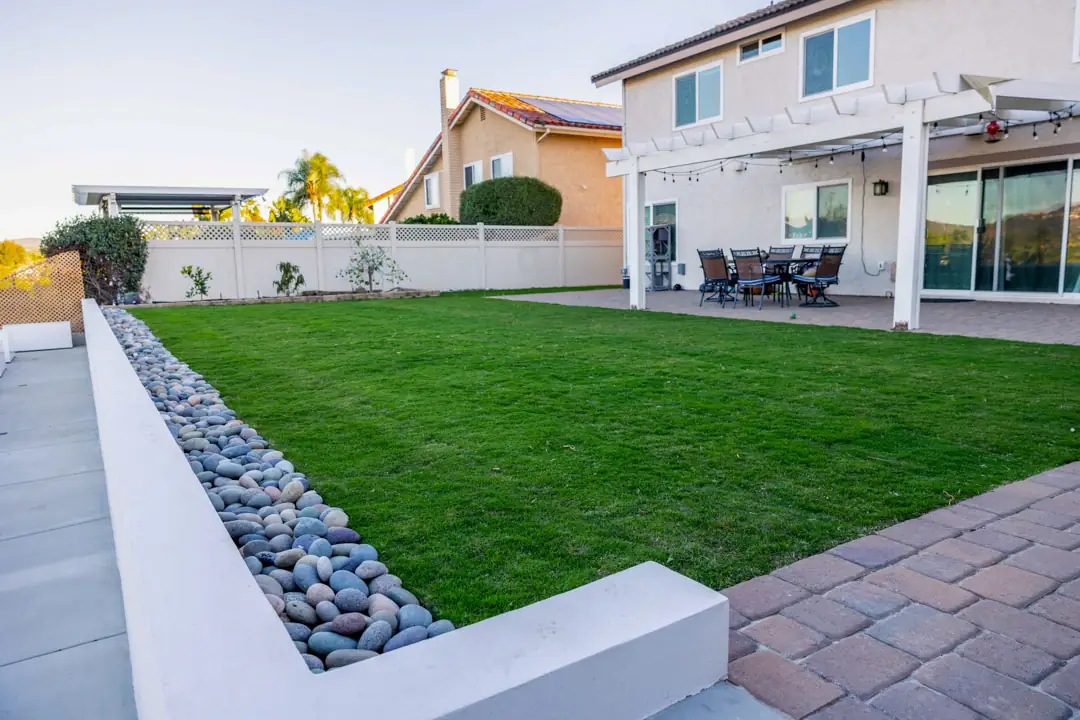
A well-designed backyard remodel creates usable square footage at a fraction of indoor construction costs. It can also double as your first line of defense against ember intrusion, if it’s planned with fire code in mind from the start.
San Diego backyard remodeling projects built around wildfire resilience typically favor:
- Concrete, paver, or stamped concrete patios instead of wood decking near the home
- Composite decking (Trex, TimberTech) rated for fire resistance where a wood-look deck is still wanted farther from structures, through our deck building team
- Code-compliant fire pits and fireplaces with proper clearance, spark screens, and shut-off valves, handled by our fire pits and fireplaces installers
- Non-combustible pergola and shade structure materials over wood lattice
An outdoor kitchen built with stone veneer, stucco, and metal appliance housing gives you the outdoor living space you actually want without introducing another combustible structure right next to your house.
Daily satisfaction has value too. A backyard you can actually use, built with materials that don’t put your home at risk, is worth more than one that just looks good in photos.
As regional wildfire risks escalate, safeguarding San Diego homes from smoke and embers is an urgent necessity.
ADUs and Pools: Building Wildfire Resilience Into Every Square Foot
If you’re adding an ADU or a pool this year, wildfire resilience should be part of the design brief from day one, not an afterthought bolted on later.
As a San Diego ADU builder, we design accessory dwelling units with the same fire-rated siding, ember-resistant vents, and defensible-space setbacks as the main house. It doesn’t make sense to harden one structure on your lot and leave the other exposed. Our ADU projects go through the same design-build process, so permits, fire code compliance, and construction stay under one roof.
Pools present a different opportunity. Working with a pool builder who understands defensible space means the pool deck itself, usually concrete or paver, becomes part of your non-combustible perimeter rather than just a recreation feature. Our custom pool designs often double as a firebreak between the house and any hillside vegetation at the back of the property.
The Cost of Wildfire-Resilient Remodeling in San Diego (and the ROI)
Homeowners often assume fire hardening means spending a fortune. It doesn’t have to, especially if it’s rolled into a remodel you were planning anyway.
Fiber cement siding costs more upfront than untreated wood siding, but it also lasts longer and needs less maintenance. Ember-resistant vent screens are a minor line item compared to a full re-roof. Non-combustible groundcover and paver pathways often cost about the same as the mulch and bark alternatives they replace.
California’s own numbers back this up: every dollar invested in home hardening returns $1.70 in broader economic activity, according to the NRDC. On the individual homeowner level, that translates into lower insurance premiums, fewer emergency repairs after a fire event nearby, and stronger resale value.
Buyers in San Diego increasingly ask whether a home has been hardened against wildfire risk. Homeowners who can answer “yes” with documentation have a real advantage.
Did You Know? Every $1 invested in California home hardening returns $1.70 in broader economic activity.
Source: NRDC
Why a Design-Build Contractor Makes Wildfire-Resilient Remodeling Simpler
Wildfire-resilient remodeling touches almost every trade: siding, roofing, HVAC, landscaping, hardscape, and sometimes structural work.
Coordinating that across separate contractors is a headache most homeowners don’t have time for. As a full-service design-build contractor, we handle every phase of your remodel, from the initial fire-risk assessment through final inspection.
That means one set of drawings, one fixed-price contract, and one team accountable for the outcome. We pull the permits, coordinate with the city inspector, and make sure your project is built safely and legally, including sign-off on any Zone Zero or defensible-space requirements specific to your property.
From first concept through final construction: one trusted team, not multiple vendors, managers, or crews. No mystery project managers, no surprises.
The price we quote is the price you pay. No surprise change orders, no separate invoices from three different subcontractors who blame each other when something doesn’t line up.
We offer a no-pressure consultation to walk your property, evaluate your exposure, and tell you honestly what needs to change and what doesn’t. That’s true whether you’re in our service areas along the coast, up North County, or on a canyon-adjacent lot in East County.
Wildfire-resilient remodeling isn’t about fear. It’s about making sure the next bad smoke day, or worse, doesn’t cost you your home.
Protecting San Diego homes from smoke and ember means treating your exterior, your landscaping, and your indoor air systems as one connected project, not three separate to-do lists. Between the February 2027 compliance deadline, rising smoke exposure across the region, and the real ROI on home hardening, there’s rarely been a better time to fold fire resilience into whatever remodel you’re already planning.
We evaluate your home during an on-site consultation and tell you honestly what wildfire-resilient remodeling should look like for your specific lot, budget, and timeline. Design, engineering, permits, and construction under one roof, so you’re not managing five vendors to get one job done.
You can see recent projects and hardening work on our Facebook page or follow along on Instagram for a closer look at finished builds.
Frequently Asked Questions
Is wildfire-resilient remodeling worth it for San Diego homes in 2026?
Yes. With smoke exposure days rising sharply and two-thirds of San Diego homes sitting in high fire hazard zones, wildfire-resilient remodeling addresses both safety and resale value at the same time.
What is Zone Zero and does my San Diego home need to comply?
Zone Zero is the 0-5 foot combustible-free perimeter required around homes in high fire hazard severity zones, with existing homes required to comply by February 2027. If your property sits in one of these zones, the requirement applies to you.
What is the best fire resistant siding for a San Diego home?
Fiber cement, stucco, and metal panel siding all outperform untreated wood siding when it comes to ember resistance. Pairing fire resistant siding with 1/8-inch ember-resistant vent screens closes the two most common ignition points on a home.
Do HVAC upgrades actually help with wildfire smoke indoors?
Yes. MERV 13+ filters, sealed attic access, and dedicated filtered fresh-air intake meaningfully reduce indoor particulate matter during high air quality index days caused by regional wildfire smoke.
Can a backyard remodel help protect my home from embers?
A thoughtfully designed San Diego backyard remodeling project using pavers, concrete, and non-combustible materials near the structure creates a buffer that slows ember intrusion while also adding usable outdoor living space.
Should I harden my ADU the same way as my main house?
Yes. A San Diego ADU builder should apply the same fire-rated siding, vent screening, and defensible space setbacks to an ADU as to the primary residence, since both structures sit on the same lot and share the same risk.
Does a pool count toward defensible space requirements?
A pool deck built from concrete or pavers can function as part of your non-combustible buffer zone, and a San Diego pool builder familiar with fire code can position it to interrupt vegetation lines on sloped or canyon-adjacent lots.