
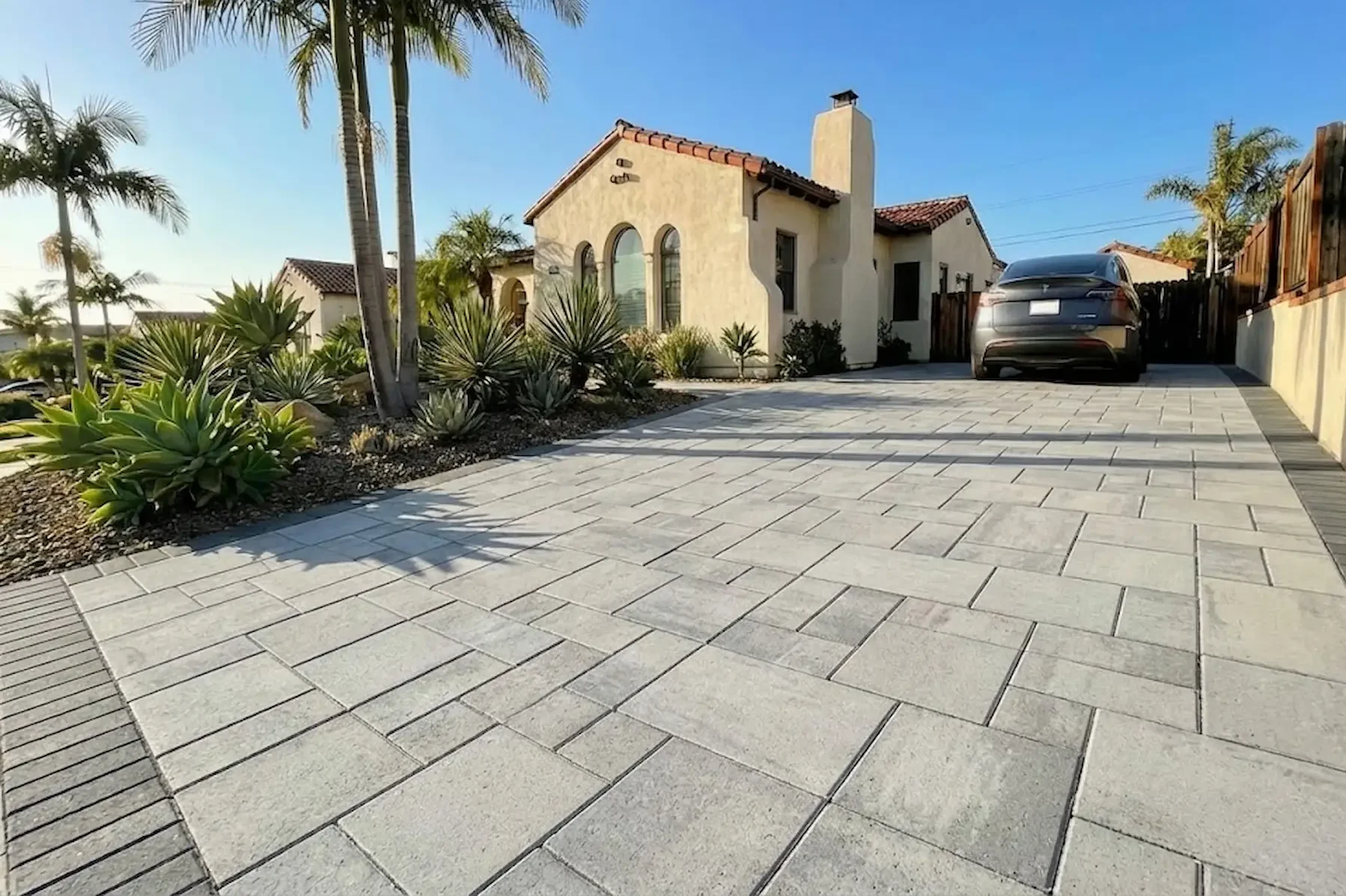
The average hardscape project runs between $10,000 and $30,000+, and that number surprises a lot of homeowners who think a new driveway or patio is a weekend, budget-friendly upgrade. Hardscape engineering and driveways are not separate topics. Every durable driveway starts with the same engineering principles that hold up a retaining wall or a paver patio, and understanding that connection is the difference between a surface that lasts twenty years and one that cracks in three.
Important Insight:
- Hardscape engineering refers to the grading, base compaction, and drainage planning underneath every driveway, patio, and retaining wall.
- Interlocking pavers now account for roughly 60% of the residential hardscape market because they flex with soil movement instead of cracking.
- A San Diego paver driveway installation and a poured concrete driveway solve different problems. We evaluate the slab during the consultation and tell you honestly which approach makes sense.
- City permits and HOA approval are two separate hurdles. A licensed san diego landscape contractor who pulls permits in-house saves you months of back-and-forth.
- Retaining walls aren’t optional decoration on sloped San Diego lots. They protect your property value and stop soil erosion before it becomes a structural problem.
- Driveways, patios, and outdoor kitchens are often designed together during a full san diego backyard remodeling project, which is more cost-efficient than tackling each one separately.
- A fixed-price, design-build contract eliminates the surprise change orders that plague most hardscape jobs.
What Is Hardscape Engineering, and Why Does It Matter?
Hardscape engineering is the technical work that happens before anyone sees a single paver or a stamped pattern.
It covers soil compaction, base depth, slope percentage for drainage, and the reinforcement needed to keep concrete from cracking under the weight of a vehicle.
The outside of your home does more heavy lifting than most people realize. Your driveway takes the weight of every car that ever parks on it, absorbs decades of San Diego sun, and has to handle whatever water runs off your roof during the rare but real winter storms.
Skip the engineering, and you get a driveway that looks fine on installation day and fails within a few seasons.
The Building Blocks Behind Every Driveway
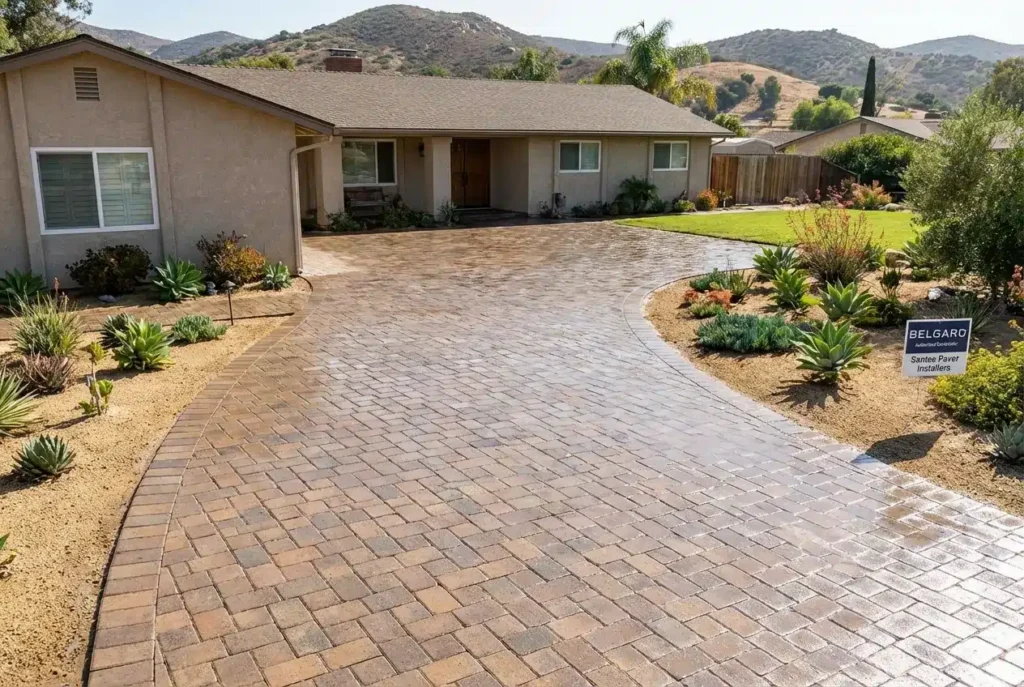
Every hardscape engineering and driveways project we build starts underground, not above it.
- Sub-base preparation: Excavation to the proper depth, followed by compacted aggregate that won’t shift under vehicle weight.
- Grading and drainage: A slight slope directs water away from the foundation instead of pooling at your garage door.
- Edge restraint: Pavers need a locked border, or they migrate outward over time.
- Reinforcement: Poured concrete driveways use rebar or wire mesh to resist cracking from soil movement and thermal expansion.
We evaluate the slab during the consultation and tell you honestly which approach makes sense for your soil, your slope, and your budget.
Choosing a Driveway Material: Pavers vs. Poured Concrete vs. Stamped Concrete
San Diego homeowners generally choose between three driveway surfaces, and each one comes with real trade-offs.
| Material | Best For | Maintenance |
|---|---|---|
| Interlocking Pavers | Flexible surfaces, sloped lots, individual repairs | Low, replace individual pavers if needed |
| Poured Concrete | Clean, uniform look, tight budgets | Moderate, can crack over time |
| Stamped Concrete | Stone or brick look without the material cost | Moderate, needs periodic resealing |
Interlocking concrete pavers now make up roughly 60% of the residential hardscape material market, largely because they handle San Diego’s expansive clay soils better than a solid concrete slab.
Large-format and textured pavers have also grown fast, now representing between 35% and 40% of residential paver sales, nearly double what they were just a few years ago.
We build all three surface types as part of our driveway installation services, and we walk you through the honest pros and cons of each before you sign anything.
Did You Know?
Interlocking concrete pavers now hold roughly 60% of the residential hardscape material market share, largely thanks to their durability across changing climates.
Source: Grounds Design
Concrete Craftsmanship: Stamped, Stained, and Textured Finishes
Concrete has come a long way past the plain gray slab most people picture.
We stamp, stain, texture, and finish concrete with polyurea coatings that add both durability and curb appeal. Stamped concrete can mimic stone or brick at a fraction of the material cost. Stained concrete adds color depth without the upkeep of natural stone, and a classic texture overlay gives you a non-slip surface around pools and walkways.
The San Diego Homeowner’s Trap: City Permits vs. HOA Rules
Here’s what catches most homeowners off guard: getting city approval and getting HOA approval are two completely different processes, and they don’t always agree with each other.
The City of San Diego cares about drainage, encroachment permits, setbacks, and structural safety. Your HOA cares about color palettes, material consistency, and neighborhood aesthetics. A driveway or retaining wall that satisfies one can still get rejected by the other.
As a full-service design-build contractor, we handle every phase of your remodel. We pull the permits, coordinate with the city inspector, and make sure your project is built safely and legally, while also managing HOA submittals so you’re not stuck translating between two sets of paperwork.
“No mystery project managers, no surprises. Design, engineering, permits, and construction under one roof.”
Retaining Walls: Engineering for San Diego’s Sloped Lots
A lot of San Diego properties sit on a slope, and that slope isn’t just a design feature. It’s a liability if it isn’t engineered correctly.
Retaining walls stop soil erosion, protect your foundation, and often unlock usable square footage on lots that would otherwise be too steep to build on. We treat retaining wall construction the same way we treat driveways: on-site consultation first, transparent fixed pricing second, and an owner-led build from start to finish.
The price we quote is the price you pay. No surprise change orders once the crew starts digging.
Beyond the Driveway: Patios, Walkways, and Full Backyard Remodels
Hardscape engineering doesn’t stop at the driveway. The same principles apply to patio installation, pool decks, and walkways.
A well-designed backyard remodel creates usable square footage at a fraction of indoor construction costs. That’s why so many of our san diego backyard remodeling clients start with a driveway consultation and end up redesigning the entire outdoor footprint of their home.
We often pair hardscape work with an outdoor kitchen build, since a paver patio and a built-in grill island share the same base prep and drainage planning.
Pairing Hardscape With Pools and ADUs
Two of the biggest outdoor investments homeowners make in San Diego are pools and accessory dwelling units, and both depend heavily on hardscape engineering.
A san diego pool builder needs a properly graded, drained deck surrounding the pool shell, or water intrusion becomes a constant problem. We coordinate custom pool construction with the surrounding hardscape so the deck, the coping, and the drainage system are engineered as one connected system, not patched together after the fact.
The same logic applies when you’re working with a san diego adu builder. An ADU project almost always needs a new driveway extension, a walkway, or a small patio to connect the unit to the main house, and that hardscape has to be engineered alongside the ADU’s foundation, not as an afterthought once construction wraps up.
What Hardscape Engineering and Driveways Actually Cost
Skilled hardscape labor in the U.S. currently runs between $50 and $120+per hour, and that rate reflects the specialized equipment and know-how required to grade, compact, and lay a durable surface correctly. Here in San Diego it generally runs in the higher end of the range, and any serious company is also going to have project manager, insurance, licensing and more that can add to the overall cost.
Materials, permit fees, and site conditions (slope, soil type, drainage needs) all shift the final number, which is why we don’t quote prices off a phone call. Every estimate starts with an on-site consultation.
Driveway and outdoor hardscape projects range significantly based on materials and design.
Contractors who bundle design, permitting, and construction into one design-build package typically see project values increase 25 to 40 percent compared to paver-only bids, because the client isn’t paying separate markups to an architect, a permit expediter, and a crew.
Did You Know?
Contractors who bundle design-build packages instead of paver-only bids see average job values rise 25% to 40%.
Source: Hardscape Marketing Crew
Finding the Right Hardscape Contractor Near You
Search “hardscape contractors near me” and you’ll get a long list of hardscape companies, general landscapers, and concrete-only outfits. Not all of them are equipped to handle engineering, permitting, and design under the same roof.
Here’s what to look for when comparing hardscape contractors:
- Licensed and insured in California, with a track record of pulled permits, not just installed pavers.
- On-site consultation before any pricing is offered, so the quote reflects your actual soil and slope conditions.
- Fixed-price contracts that spell out scope, materials, and timeline in writing.
- Owner-supervised crews, not a rotating cast of subcontractors managed remotely.
- Design-build capability, meaning one team handles design, engineering, and construction, not three separate vendors.
A good san diego landscape contractor should be comfortable walking you through drainage plans, base depth, and material trade-offs without hiding behind vague language. If a paver patio contractor can’t answer a direct question about sub-base compaction, that’s worth noting before you sign anything.
Why Homeowners Choose a Design-Build Approach
Hiring an architect, then a separate engineer, then a separate contractor is the old way of doing hardscape and driveway projects. It’s also the way most surprise costs sneak in.
From first concept through final construction: one trusted team, not multiple vendors, managers, or crews. We handle design, engineering, permits, and construction under one roof, which means there’s a single point of contact for every question, every change, and every inspection.
Daily satisfaction has value too. A driveway or patio you’re proud of every time you pull in or step outside is worth more than the line item on a spreadsheet.
Hardscape engineering and driveways aren’t separate line items. They’re one connected system that starts underground and ends with the surface you walk and drive on every day.
Whether you’re replacing a cracked driveway, adding a retaining wall on a sloped lot, or planning a full san diego backyard remodeling project around a new pool or ADU, the same rule applies: get the engineering right first, and the finish takes care of itself.
We offer a no-pressure consultation to walk your property, assess the slope and soil, and give you a fixed-price plan for your hardscape engineering and driveways project, done right the first time.
Frequently Asked Questions
How much does hardscape engineering and driveways cost in San Diego in 2026?
Most hardscape projects, including driveways, run between $10,000 and $30,000 depending on material, square footage, and site conditions. Skilled labor rates currently run $50 to $120 per hour, and slope, soil type, and drainage needs can push the total higher.
What is the difference between a paver driveway and a poured concrete driveway?
Paver driveways use interlocking units set on a compacted base, which lets them flex slightly with soil movement and makes individual repairs easy. Poured concrete driveways create a single reinforced slab that looks uniform but can crack over time if the base wasn’t compacted correctly.
Do I need a permit for a new driveway or retaining wall in San Diego?
Yes, most driveway replacements and nearly all retaining walls over a certain height require city permits, and many properties also require separate HOA approval. A design-build contractor who pulls permits in-house handles both processes so you’re not managing two sets of paperwork on your own.
Is hardscape engineering worth it, or can I just install pavers on dirt?
Skipping proper base compaction and grading is the number one reason driveways and patios fail early. Hardscape engineering costs more upfront but prevents shifting, cracking, and drainage problems that cost far more to fix later.
How long does a driveway or hardscape project take?
A standard driveway replacement typically takes one to three weeks once permits are approved, while larger hardscape projects involving retaining walls, patios, or pool decks can take four to eight weeks. Permit processing time with the city and HOA often adds several weeks before construction even starts.
Can hardscape work be combined with a pool or ADU project?
Yes, and it’s usually more cost-effective to plan them together. A san diego pool builder needs properly engineered decking, and a san diego adu builder needs connecting walkways or driveway extensions, so coordinating the hardscape with the larger project avoids redundant excavation and grading work.
What should I look for in a hardscape contractor near me?
Look for a licensed, insured contractor who offers an on-site consultation, provides a fixed-price contract, and handles design, permits, and construction as one team. Avoid contractors who quote pricing over the phone without seeing your soil, slope, and drainage conditions in person.